Versie door Update bot(overleg | bijdragen) op 18 apr 2026 om 18:31 (Nieuwe pagina aangemaakt met '<!-- Hieronder wordt een transclude page aangeroepen --> {{Versions-2.16.840.1.113883.2.4.3.11.60.40.3.9.11(EN)|1|MedicationUse2-v3.1(2026-1EN)}} <!-- Tot hier de transclude page --> ==General information<!--hdGeneralInformation-->== Name<!--hdName-->: '''nl.zorg.MedicationUse2''' link=MedicatieGebruik2-v3.1(2026-1NL)<BR> Version<!--hdVersion-->: '''3.1''' <br> HCIM Status<!--hdStatus-->:Final<br> Release<!--hdPublication-->: '''2026-…')
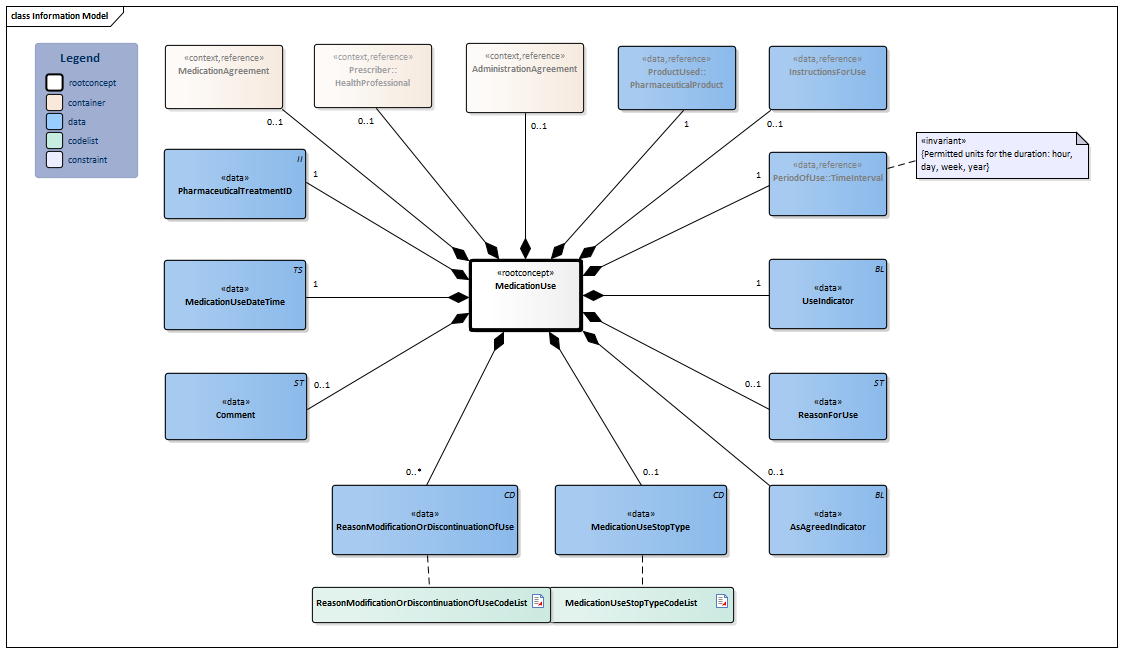
Identification of a medication treatment. A pharmaceutical treatment is defined as a treatment with a medicinal product. The PharmaceuticalTreatmentID is a technical identifier (worldwide and forever unique) that is required to record the relationship between a set of medication-related data elements. An identically defined PharmacotherapeuticTreatmentID has been added to all medication-related Health and Care Information Models (HCIMs): MedicationAgreement, MedicationAdministration2, AdministrationAgreement, MedicationUse2, MedicationDispense, and DispenseRequest.
The medication agreement to which the entered medication use refers. In case medication use is recorded as 'as agreed', the agreement to which is referred, can be stated here.
The administration agreement to which the entered medication use refers. In case medication use is recorded as 'as agreed', the agreement to which is referred, can be stated here.
The product used. This is usually medication. Food, blood products, aids and bandages do not strictly fall under the category of medication, but can be recorded as well.
In principle, this will be the prescribed product, but the product used may differ from the prescribed product.
Instructions for the use of the medication, e.g. dose and route of administration. In the event of medication use, this is the pattern of use established by the patient or that the patient followed.
Medication use can be recorded for a certain moment or over a certain period. Thus, medication use can be recorded multiple times during the use of medication. The usage period is the period or moment over which the data is recorded.
Start date: This is the time at which the agreement was to take effect (or took effect or will take effect).
Duration: The intended duration of use. E.g. 5 days or 8 weeks. It is not allowed to indicate the duration in months, because different months have a variable duration in days.
End date: The time at which the period of use ends (or ended or will end). To avoid confusion between 'to' and 'up until and including', the submission of time is always mandatory for the end date.
In de maand mei heb ik regelmatig paracetamol gebruikt.
Ulcusprofylaxe
Vanaf 1 september 2012 gedurende 5 dagen 1x per dag om 8uur 40 mg (=1 st)
iv
40 mg (=1 st)
1x per dag om 8.00 uur
(Mogelijke) bijwerking
Tijdelijk gestopt vanwege toenemende bijwerkingen: duizeligheid en misselijkheid.
subcutaan
2500 IE
1x per dag om 18.00 uur
Instructions
The rules about linking an existing PharmaceuticalTreatmentID or to issue a new PharmaceuticalTreatmentID have been determined by the Medication Process information standard established by Nictiz.
Assigning authorities
The identifying numbers are issued by the following authorities
Technical specifications in HL7v3 CDA and HL7 FHIR
To exchange information based on health and care information models, additional, more technical specifications are required.
Not every environment can handle the same technical specifications. For this reason, there are several types of technical specifications:
HL7® version 3 CDA compatible specifications, available through the Nictiz ART-DECOR® environment
HL7® FHIR® compatible specifications, available through the Nictiz environment on the Simplifier FHIR



 MedicationUse

 PharmaceuticalTreatmentID


 or as spreadsheet