Nieuwe pagina aangemaakt met '==General information<!--hdGeneralInformation-->== Name<!--hdName-->: '''nl.zorg.template.PatientQuestionnaire''' Bestand:NL.png|link=PatientVragenlijst-v1.0(NL)...'
A Patient questionnaire is a structured questionnaire in which a care provider asks the patient or a contact person a number of questions about his health, (disease) history or experiences during a care process.
This is a template HCIM. For actual use, meaningful element names and filling of the value lists will have to be provided for derived HCIMs.
Purpose
The purpose of a patient questionnaire is to request information from the patient that is important to know for the treatment, the result of a treatment or his experiences in the care process.
Evidence Base
Question (text) and answer (options) connected to container 'Item' in the information model
Validated and often translated questionnaires pose a challenge in terms of version management. This is only partly the concern to the manager of a single HCIM questionnaire, but the publisher or author of the questionnaire is in the lead.
For example, an English version of a questionnaire can have various translations into other languages ??and this translation can also have various versions. Often it is not just a translation, but the questions are more applied to the country in which the respondents are located. An English question "Are you able to walk uphill?" Is often adapted for the Netherlands to "Are you able to walk up the stairs?" Simply because there are few hills in the Netherlands. This is often done by special agencies and translations must also be validated by the publisher of a questionnaire. Internationally, people often speak more often of 'cultural adaptations' than simply translations. Due to the validation in various studies, when a new version of an existing questionnaire is published in the maker's native language, it will take quite some time for this list to be translated into all languages.
In addition, new versions can contain changes in the text of the question as well as the answer options and / or their weighting when calculating scores. Backward compatibility is not always possible. The rule of thumb is that a receiving system or person must be able to receive and map answers from various versions and process them properly in, for example, reports including benchmarks.
Also in the healthcare proces it is desirable that it is always possible for the receiving care provider to see exactly to which version of a question a patient has answered, but also which questions has been skipped by the patient or when questionnaires have not been completed at all.
In addition to version management of question text and answer options (see example in the value lists), there are a number of challenges surrounding absence of an answer to a questionnaire question. This is important for the analysis of data and / or benchmarks. There are several reasons why an answer to a question is not received which are also important to the receiving healthcare provider, analysis or benchmarks. for example:
This may have been skipped by the person completing this.
The person completing the questionnaire can only have completed a questionnaire halfway.
The person completing the question may never have seen the question because the question only became visible through previous answers provided.
Other preconditions specific to the patient's situation (for example, gender, certain condition that prevents certain questions from appearing).
How to do this depends on the questionnaire. In due time, more information will be available on the zibs wiki about the possibilities.
Information Model
Type
Id
Concept
Card.
Definition
DefinitionCode
Reference
NL-CM:21.2.1
[PatientQuestionnaire]
Root concept of the [PatientQuestionnaire] information model.This root concept contains all data elements of the [PatientQuestionnaire] template.
NL-CM:21.2.30
[Respondent]
0..1
Container of the [Respondent] concept.This container contains all data elements of the [Respondent] concept.
Columns Concept and DefinitionCode: hover over the values for more information
For explanation of the symbols, please see the legend page
Instructions
With this template, single HCIMs can be made that model one questionnaire with one or more sections.
If a HCIM of a questionnaire becomes very large and it contains a complex flow with conditionally visible or hidden questions, the modeller may decide to divide it into several smaller HCIMs. Alternative is to model these (pre-)conditions in a HCIM with the help of constraints.
It is also possible to refer to a website or place where this information can be found instead of doing this in a HCIM.
The sequence of completing and exact design of a questionnaire may be difficult to described in a HCIM and this is actually not what an HCIM is intended for. This information must be available from the publisher or creator of the questionnaire. not a modeller of an HCIM. The publisher is also the content manager of a questionnaire.
With every change by the content manager, one should check and track whether a single HCIM must be adapted.
The version management of validated questionnaires in particular requires attention and can be complex due to various translations in circulation.

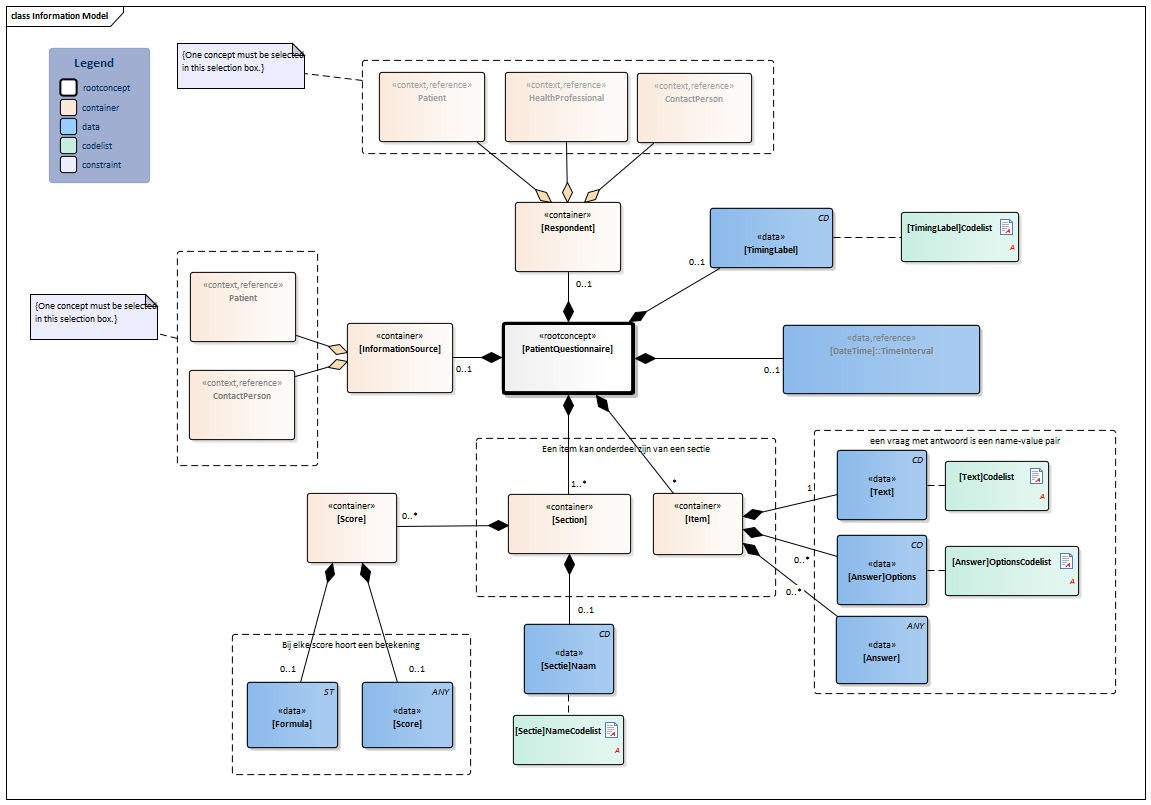

 [PatientQuestionnaire]


 Patient


